Mobile apps · Fitness
Fitness app development company for workout, coaching and tracking apps
We build workout, coaching, nutrition, activity-tracking and studio-booking apps for iOS and Android, with the health-data integrations, subscriptions and video delivery that decide whether members keep paying after the first month.
Short answer
Fitness app development covers workout, coaching, nutrition, activity-tracking and studio-booking apps, usually connected to Apple HealthKit, Android Health Connect, wearables and App Store or Google Play subscriptions. Innovation Insight is a fitness app development company building them with a senior team in Lahore and Sialkot. A mobile MVP costs $20k to $45k; our calculator puts a typical workout app at $23k to $42k. A full product with coaching, video and integrations costs $50k to $150k+.
Reviewed by Zain Khalid Malik, CTO & Co-founder · Updated
What kind of fitness app are you building?
"Fitness app" covers products that share a login screen and little else. A workout library lives or dies on video and programming. A tracker lives on sensor data and battery life. A coaching app is really a messaging and scheduling product. We pin down which one you are building in the first week, because it decides the stack, the integrations and most of the budget.
| App type | What the product is | The hard part |
|---|---|---|
| Workout and programme library | Video workouts, plans that progress week to week, streaks and reminders | Video delivery and offline downloads, programme logic that adapts when people skip sessions |
| Personal coaching | Coach assigns plans, checks in, reviews form videos, chats with clients | Coach tooling, async video review, payment rules for one-to-one services |
| Nutrition and calorie tracking | Food logging, barcode scanning, macros, meal plans | Food database quality and licensing, fast search, offline logging |
| Activity and GPS tracking | Runs, rides and hikes recorded with GPS, splits, routes and a social feed | Background location on iOS and Android, battery use, sync after a dead zone |
| Studio and gym booking | Class timetables, bookings, memberships, check-in, waitlists | Capacity rules, late-cancel fees, integration with the studio's existing system |
| AI-assisted training | Generated plans, form feedback from video, adaptive recommendations | Evaluating AI output for safety, keeping inference costs per user in check |
Health data integrations: HealthKit, Health Connect and wearables
Most fitness apps both read and write health data. Reading steps, heart rate and workouts from the phone saves users from double entry; writing your workouts back means they show up in the platform's own health app. The platform picture changed in 2026, so check every integration plan against the dates below (checked October 2026).
| Source | How you get the data | What to know |
|---|---|---|
| Apple HealthKit | On-device framework, per-data-type read and write permissions requested at runtime | No server API: your iOS app reads on the device and syncs to your backend. Apple's guideline 5.1.3 bars using HealthKit data for advertising and storing personal health information in iCloud |
| Android Health Connect | On-device store with per-data-type permissions, Android 9 (API 28) and later | Google's recommended path for mobile-first apps. Google's migration guide says the Google Fit APIs, including the REST API, are supported only until the end of 2026 |
| Google Health API | Cloud API from Google | Google's recommended replacement for cloud-based Google Fit integrations. New builds should not start on Google Fit |
| Fitbit | Legacy Fitbit Web API | Fitbit's reference says support for the legacy Web API ends on 30 September 2026 and the API is turned off on 30 October 2026, with migration to the Google Health API |
| Garmin | Garmin Connect Developer Program: Health API and Activity API pushed to your server | Access goes through Garmin's programme with throttled production limits and branding rules |
| Oura and Whoop | Public OAuth APIs with webhooks for sleep, readiness, recovery and workouts | Data arrives on your server after the device syncs to the vendor's app, so it is minutes or hours late, not live |
Two engineering details save the most grief. First, deduplication: the same run can arrive from the watch, the phone and a third-party app, so every record carries its source and we merge overlapping sessions by rule. Second, permissions are revocable at any time on both platforms, so the app has to keep working, with a clear prompt, when a user switches a data type off.
Features by user type
| Member | Coach, trainer or studio | Admin |
|---|---|---|
| Onboarding with goals, experience level and injuries | Client roster with status, last activity and missed check-ins | Content management for workouts, programmes, exercises and recipes |
| Plans that adapt to missed sessions and progress | Plan builder with templates and drag-and-drop weeks | Subscription and entitlement view across App Store, Google Play and web |
| Video workouts with offline download | Async form-check reviews on client video with comments | Coach onboarding, verification and payouts |
| Tracking: workouts, sets, food, weight, sleep | Chat and scheduled check-ins with templates | Push campaigns and in-app messages by segment |
| HealthKit and Health Connect sync, wearable connections | Class timetables, capacity and waitlists (studios) | Moderation of community posts and reports |
| Streaks, badges, challenges and a community feed | Earnings, client billing and cancellations | Analytics: activation, week-4 retention, churn by plan |
| Subscription management, restore purchases | Class check-in by QR code or member list | Data export and deletion requests |
Subscriptions: App Store, Google Play, Stripe and RevenueCat
Billing rules for fitness apps depend on what is being sold, and getting it wrong is a common cause of App Store rejection. Apple's guidelines (checked October 2026) say:
- Digital content and features used inside the app, such as a workout library or premium plans, must use in-app purchase (guideline 3.1.1). Google Play has an equivalent rule for Play billing.
- Real-time one-to-one services between two people, which Apple names fitness training as an example of, may use other payment methods. One-to-few and one-to-many real-time services, such as live group classes in the app, must use in-app purchase (3.1.3(d)).
- Services consumed outside the app, such as an in-person studio class, must not use in-app purchase; you take the card through Stripe or Apple Pay (3.1.3(e)).
Most fitness apps end up with two or three billing channels: App Store, Google Play and web. We usually put RevenueCat or a small entitlement service of our own in front of them, so the app asks one question ("does this member have premium?") and the answer is correct whether they paid on iPhone, Android or the web. Server notifications from Apple and Google drive renewals, refunds, grace periods and billing retry, so access never depends on the app being opened.
Video delivery
Workout video is the largest running cost in many fitness apps. We encode once into adaptive HLS renditions, serve through a CDN, and let members download sessions for the gym basement with no signal. For a small library a managed service such as Mux or Cloudflare Stream is simplest; for a large catalogue, S3 with FFmpeg transcoding and CloudFront costs less per minute watched. Signed URLs keep premium video behind the subscription, and we measure start time and rebuffering on real phones, not on office Wi-Fi.
Health data privacy and compliance
Most consumer fitness apps are not covered by HIPAA, and that does not mean health privacy law ignores them. The rules that usually apply:
| Rule | When it applies | What we build in |
|---|---|---|
| FTC Health Breach Notification Rule | Vendors of personal health records and related entities, which the FTC applies to health apps and connected devices; the rule was updated in 2024 | Breach detection and an incident runbook, notification to users, the FTC and, for breaches affecting 500 or more people, the media; no sharing of health data with ad platforms without authorisation |
| Washington My Health My Data Act | Any business handling consumer health data of Washington residents, including out-of-state companies; most duties applied from 31 March 2024 | Separate consent for collecting and for sharing health data, a stand-alone consumer health data privacy policy linked from the home page, deletion on request |
| GDPR (EU and UK) | Health data is special category data under Article 9 | Explicit consent screens per purpose, data minimisation, EU or UK hosting where needed, export and erasure flows |
| Apple and Google store rules | Any app reading HealthKit or Health Connect data | No advertising use of health data, accurate privacy labels and data safety forms, written justification for each data type |
| HIPAA | Only when you work for or on behalf of a covered entity, such as a clinic or health plan running the programme | BAAs with every vendor, audit logging, encryption and access controls. See our HIPAA-compliant development page |
Our default for every fitness build: health data stored separately from marketing data, analytics events that never contain health values, and an SDK review before any third-party library goes in, because ad and analytics SDKs are where most health-data leaks start.
What a fitness app costs
Figures from our app cost calculator for a senior offshore team, with the same scope at typical US agency rates for comparison. Our published mobile MVP band is $20k to $45k; a full product with coaching tools, video, wearables and a web dashboard sits in our $50k to $150k+ band.
| Scope | Our cost | Timeline | US agency, same scope |
|---|---|---|---|
| Workout or coaching app MVP: accounts, plans, video, subscriptions, admin | $23k to $42k | 10 to 18 weeks | $82k to $222k |
| GPS activity tracker like Strava: offline recording, maps, social feed | $28k to $51k | 10 to 19 weeks | $99k to $268k |
| Nutrition tracker like MyFitnessPal: food search, logging, offline sync | $26k to $48k | 10 to 18 weeks | $93k to $253k |
| Full fitness product: coaching, wearables, community, web dashboard | $46k to $84k | 12 to 22 weeks | $163k to $440k |
The fitness app cost guide breaks these down feature by feature, and the Strava and MyFitnessPal posts cover those two app shapes in detail. Running costs to plan for: video delivery, food database licensing if you do not build your own, push and email, and AI inference if plans are generated.
How a fitness app project runs
- Discovery (one to two weeks, $3k to $8k): the member journey for the first 30 days, the billing channels, which health data you read and write, and the privacy rules that apply.
- Clickable prototype tested with five to ten real members or coaches.
- Build in two-week sprints with TestFlight and Play internal builds every sprint, so you train with the app while it is being built.
- Store submission with privacy labels, health-data justifications and subscription review notes prepared in advance.
- Launch and iterate on retention, with a maintenance retainer of $1.5k to $8k per month covering OS updates, platform API changes and new features.
Fitness and consumer app work we have shipped
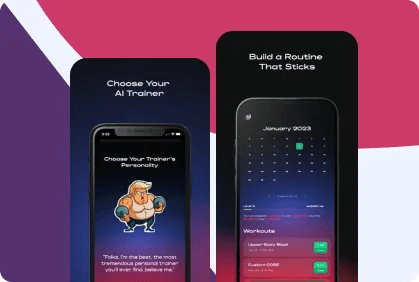
- Toned.ai: an AI fitness app taken from concept to a launched mobile product in five months by three engineers, an ML engineer and a designer. Discovery defined the first release and the AI capabilities it depended on; we built and evaluated the AI components iteratively behind simple app flows, and developed the app and backend in parallel with regular builds for the founders to test.
- LogFish: a React Native app live on the App Store and Google Play with offline-first logging that syncs when signal returns, live GPS tracking on Mapbox, App Store and Google Play subscriptions alongside Stripe payments and payouts, and an FFmpeg video pipeline delivered through CloudFront. Outdoor recreation rather than fitness, but the same background location, offline sync and subscription problems.
Choosing the framework comes next: our Flutter and React Native pages compare them, and the fitness app features and tech stack post lists the libraries we use. For the broader picture, see mobile app development and our published pricing.
Sources and further reading
Next step
Tell us what you're building and get a written estimate.
A senior engineer replies within one business day. NDA on request.
Products we've shipped, and what happened next.
Case studies written from the technical documentation of each project: the stack, the scale and the outcome.


Questions we get asked a lot.
How much does fitness app development cost?
A fitness mobile MVP costs $20k to $45k with our team; the calculator's workout app preset lands at $23k to $42k over 10 to 18 weeks. A full product with coaching tools, video, wearables and a web dashboard costs $50k to $150k+.
Should a new fitness app integrate with Google Fit?
No. Google's documentation says the Google Fit APIs are supported only until the end of 2026. New Android apps should use Health Connect on the device and the Google Health API for cloud integrations.
Does my fitness app need to be HIPAA compliant?
Usually not. HIPAA applies when you work for or on behalf of a covered entity such as a clinic or health plan. Consumer fitness apps are still covered by the FTC Health Breach Notification Rule, state laws such as Washington's My Health My Data Act, GDPR in Europe and the app store health-data rules.
Do I have to use Apple in-app purchase for subscriptions?
For digital content and premium features used in the app, yes. Real-time one-to-one coaching may use other payment methods, and in-person classes consumed outside the app must be paid by card, not in-app purchase. Live group classes inside the app need in-app purchase.
Which wearables can a fitness app connect to?
Apple Watch through HealthKit, most Android wearables through Health Connect, and Garmin, Oura and Whoop through their own developer APIs. Fitbit data moves to the Google Health API as the legacy Fitbit Web API is turned off in October 2026.
Flutter or React Native for a fitness app?
Both work well. React Native suits teams with web React skills and heavy use of native health and location modules; Flutter suits apps with custom animated UI. We choose with you in discovery based on your team and integrations.