Web development · Python and FastAPI
Python and FastAPI development services for AI products and data-heavy back ends
We build Python back ends with FastAPI: APIs in front of language models and machine-learning services, data pipelines, and the workers and queues around them, typed and tested like any other production system.

Short answer
FastAPI is a Python framework for building typed, asynchronous APIs, and it has become the standard choice for AI and data back ends. Innovation Insight has shipped FastAPI services for retrieval pipelines, audio machine learning and AI mobile apps. An AI feature added to an existing product costs $8k to $60k, an AI-powered MVP $25k to $60k, and dedicated senior Python engineers start from $4,000 a month.
Reviewed by Zain Khalid Malik, CTO & Co-founder · Updated
Why teams choose FastAPI
Python is where machine-learning and data libraries live, so any product that calls a model, builds embeddings or processes data ends up with Python somewhere in the stack. FastAPI makes that Python a proper API. Request and response shapes are declared with type hints and validated by Pydantic, so bad input is rejected before it reaches your code. OpenAPI documentation is generated from the same types. Endpoints are asynchronous, which suits work that spends most of its time waiting on a model, a database or another service.
| Question | FastAPI | Django | Node.js (NestJS) |
|---|---|---|---|
| Best at | APIs, AI and data services | Admin-heavy products with relational data | Product APIs and real-time features in TypeScript |
| Built-in admin and ORM | No, you choose | Yes | No, you choose |
| Async by default | Yes | Partly | Yes |
| Typed contracts and generated docs | Yes, from type hints | With extra packages | Yes, with decorators |
| Access to ML libraries | Direct | Direct | Through a separate Python service |
We often use both: a TypeScript API for the product and a FastAPI service for the AI and data work. That is the shape of GovDoc AI and Cuts Like A Knife, described below.
What we build with Python and FastAPI
- APIs in front of language models: prompt handling, streaming responses, tool calls, caching and per-request cost limits.
- Retrieval pipelines: document parsing, chunking, embeddings and vector search behind a clean endpoint.
- Machine-learning services: model inference, embeddings and recommendations deployed separately from the main application.
- Data pipelines and background workers: ingestion, scheduled jobs, queues and retries.
- Back ends for mobile and web products where the team prefers Python.
- Internal automation and integration services.
How we make a FastAPI service production-ready
| Concern | Our approach |
|---|---|
| Validation | Pydantic models on every request and response; strict settings loaded from the environment |
| Database | PostgreSQL with SQLAlchemy and Alembic migrations, or MongoDB where documents fit |
| Long-running work | Queues and workers for anything slower than a web request; status endpoints or webhooks for results |
| Blocking code | CPU-heavy and blocking calls moved off the event loop so one slow request does not stall the rest |
| Testing | pytest with fixtures, contract tests against the generated OpenAPI schema, evaluation sets for AI output |
| Security | Authentication and per-object authorisation on every route, rate limits, input size limits |
| Deployment | Docker images on AWS ECS, Lambda or your platform, with CI/CD and health checks |
| Observability | Structured logs, traces, error tracking and cost per request for model calls |
Python and FastAPI work we have shipped
- GovDoc AI: Python services on FastAPI for embeddings and extraction, deployed as AWS Lambda functions and ECS containers, behind a NestJS API. The pipeline uses Cohere embeddings, OpenSearch and Claude on AWS Bedrock to extract more than 50 data points per contract.
- Cuts Like A Knife: a FastAPI machine-learning service for a music licensing platform, with natural-language search through OpenAI and LangChain and audio similarity using OpenL3 embeddings indexed in FAISS and Amazon OpenSearch. It deploys through its own pipeline, separate from the NestJS API.
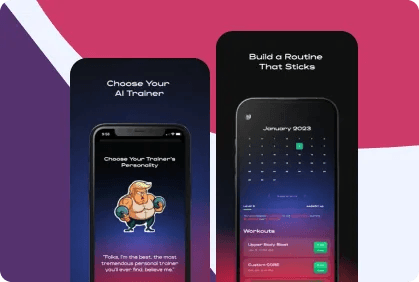
- Toned.ai: a Flutter fitness app with AI features served by a Python and FastAPI back end on PostgreSQL and AWS.
What it costs
| Scope | Range | Timeline |
|---|---|---|
| AI or data feature added to an existing product | $8k to $60k | 3 to 10 weeks |
| AI-powered MVP with a Python back end | $25k to $60k | 10 to 16 weeks |
| Web MVP on a Python back end | $15k to $40k | 8 to 14 weeks |
| Dedicated senior Python engineer | From $4,000 a month | Monthly |
| Hourly work, senior engineers | $25 to $49 an hour | As needed |
How we work
- Discovery: what the service must do, its inputs and outputs, expected load and where it sits beside your existing system.
- Contract first: Pydantic models and the OpenAPI schema are agreed before the logic is written.
- Build in two-week sprints with tests, a staging environment and, for AI features, an evaluation set run on every change.
- Hardening: load test, security review, cost limits and alerts.
- Handover or ongoing team: documentation and runbooks, then a retainer or dedicated engineers.
Sources and further reading
Next step
Tell us what you're building and get a written estimate.
A senior engineer replies within one business day. NDA on request.
Products we've shipped, and what happened next.
Case studies written from the technical documentation of each project: the stack, the scale and the outcome.



Questions we get asked a lot.
FastAPI or Django?
FastAPI for APIs, AI services and anything asynchronous. Django when you want a built-in admin, ORM and conventions for a relational product. We build with both.
Can FastAPI handle production traffic?
Yes. It runs on asynchronous servers and scales horizontally in containers. Reliability depends on keeping blocking work off the event loop and moving long jobs to workers.
Do you build the front end too?
Yes. A FastAPI back end usually pairs with a Next.js or React front end, or a Flutter or React Native app, built by the same team.
Can you add a Python AI service to our existing Node or .NET product?
Yes. That is a common setup: your current API stays in place and calls a separate Python service for retrieval, embeddings or model inference.
Can we hire Python developers instead of a project team?
Yes. Dedicated Python engineers join your team on a monthly basis; see the hire Python developers page for rates.
Where do you deploy FastAPI?
AWS ECS or Lambda most often, also Azure and Google Cloud, in your account and defined as code.